
Choosing the best Firefighting Drone begins with the incident, not the camera.
A high-rise fire demands different capabilities than a grassland response. Heat resistance, flight endurance, thermal imaging, payload capacity, and weather stability can change operational results. A clear thermal image may reveal a trapped person through smoke. A stable video feed may help commanders track roof damage without sending crews into unnecessary danger.
Charles Werner, former Charlottesville Fire Chief and founder of DRONERESPONDERS, describes drones as “a force multiplier for public safety.” That idea matters, but it needs practical limits. A Firefighting Drone supports trained responders; it does not replace their judgment, communication, or rescue procedures.
Look closely at the details. Can the drone remain airborne during strong wind? Can its thermal sensor distinguish a hot roof from an active fire? Does the controller remain readable while wearing gloves? Battery swapping should be fast. Maintenance should be simple. Data storage should be secure and easy to review after an incident.
Small details matter.
Buyers should also examine pilot training, manufacturer support, spare parts, software updates, and integration with existing command systems. A lower purchase price may become expensive after repeated battery failures or unavailable repairs. That part is easy to underestimate.
There is no perfect aircraft for every department. A compact model may work well for rapid assessment, while a heavier platform may suit extended thermal monitoring. The right choice balances safety, evidence, reliability, and the uncomfortable possibility that advertised performance may not match harsh field conditions. Testing under realistic conditions remains essential before trusting any Firefighting Drone during a critical emergency.
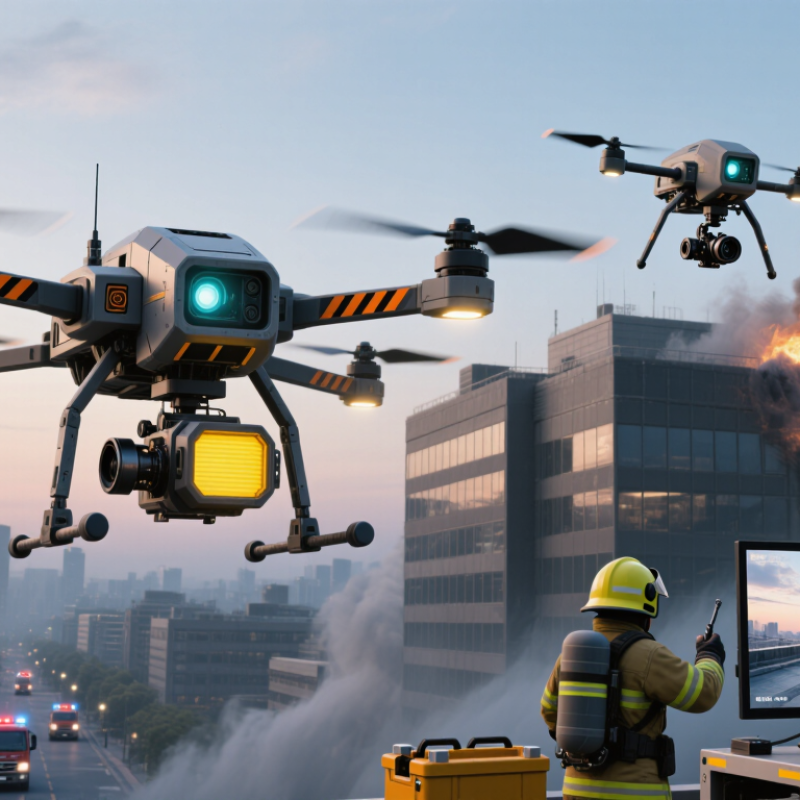
Firefighting drones give emergency teams a safer view before people enter smoke-filled areas. They can map heat, locate trapped occupants, inspect roofs, and guide hose teams through blocked access routes. In a warehouse drill, a thermal camera may reveal a hot ceiling void hidden above ordinary smoke. Live video also helps incident commanders compare changing conditions from a safer distance. Visibility remains crucial.
When choosing a firefighting drone, examine thermal resolution, low-light video, flight endurance, weather protection, and secure communications. A useful payload may include a spotlight, loudspeaker, gas sensor, or compact water delivery system. Each addition affects weight and battery life. Obstacle avoidance can reduce collisions, but it cannot replace a trained pilot or a clear flight plan. Operators should test signal performance around concrete walls, metal structures, and heavy interference before an emergency. They must also follow local aviation and emergency-response requirements.
Water-carrying models can support limited suppression, yet they are not substitutes for fire engines or rescue crews. Strong winds, dense smoke, heat, and poor satellite signals may quickly reduce performance. This is where product claims need careful checking. A drone may look impressive during a calm demonstration and struggle beside a burning industrial building. Teams should record flight times, sensor errors, landing problems, and missed images during repeated drills. That evidence exposes weaknesses early, although no test perfectly reproduces a real emergency.

Choosing a firefighting drone starts with the mission, not the camera. In field evaluations, flight stability often matters more than advertised speed. Test the aircraft near smoke, heat, wind, and uneven air currents. A stable hover helps crews inspect roofs, windows, and access routes without risky repositioning. Battery endurance should include payload weight and return reserves. Eighty minutes on paper may become forty during a hot, windy operation. Keep margins generous. Our early tests exposed a weakness: fast drones were harder to control beside tall structures.
Payload capacity affects every decision. A thermal camera, visible-light sensor, spotlight, speaker, or mapping unit adds weight and drag. Check the usable payload, not only the maximum lift figure. The drone should remain responsive when carrying its full operational load. Mounting also matters. A poorly balanced sensor can increase vibration and blur images during movement. Operators should rehearse battery swaps, attachment checks, and emergency landing procedures. Small delays become serious near active fire zones. I would rather carry fewer tools reliably than overload one aircraft.
Thermal imaging is valuable, but it is not an automatic truth detector. Look for temperature range, image detail, refresh rate, and performance through smoke. A hot roof patch may indicate fire, sunlight, metal, or trapped heat. Cross-check thermal findings with visual images and crew observations. Test the system at different distances and angles before deployment. Calibration and operator training deserve equal attention. During one exercise, a reflective surface created a misleading hotspot. That mistake was useful. It reminded us that clear images can still support poor decisions. Choose equipment with recorded test results, understandable controls, and dependable data storage.
How to Choose the Best Firefighting Drone?
Water delivery is useful, but it should not dominate your evaluation. NFPA’s Fire Loss in the United States During 2023 estimated 1,388,500 fires nationwide. A drone carrying a thermal camera can reach a roof, warehouse, or forest edge before crews enter. Compare payload capacity, discharge distance, refill time, wind stability, and flight duration. A small tank may cool hot spots, but it rarely replaces a hose line. That limitation matters.
Smoke detection requires more than an ordinary camera. Thermal imaging can reveal heat behind smoke, while gas sensors may identify dangerous changes in air quality. NIST research on fire dynamics shows that conditions can change rapidly inside enclosed spaces. Choose systems that record temperature patterns, map locations, and transmit stable images through smoke. Test them at night. Bright flames can still confuse basic sensors.
Rescue features deserve equal attention. A loudspeaker, spotlight, two-way audio, and obstacle avoidance can help locate trapped occupants. Some operations may require a controlled delivery mechanism, but payload limits and local aviation rules must guide every decision. FEMA’s National Preparedness Report emphasizes interoperable information during emergencies. Therefore, the drone should share clear data with incident commanders, not create another screen to monitor. My practical concern is simple: rescue functions often look impressive in demonstrations, yet battery loss, heavy rain, and poor radio coverage can reduce performance sharply. Test the imperfect conditions.
Mission priorities vary: water-delivery operations emphasize payload and flow rate, smoke detection depends on thermal and visual sensing, while rescue missions require endurance, payload capacity, lighting, and communication equipment.
The chart uses a 0–100 operational priority score for each mission type. Higher values indicate that the capability is more important when selecting a drone for that mission.
How to Choose the Best Firefighting Drone?
A firefighting drone must protect people before it collects impressive footage. Look for collision avoidance, automatic return-to-home functions, and encrypted communication. Thermal imaging can reveal hotspots behind walls or under roofing materials. Test it near smoke, heat, wind, and poor visibility. Laboratory claims are useful, but field evidence matters more.
Durability should match the incident environment. A sealed airframe can resist dust, water spray, and sudden temperature changes. Check its operating range, battery performance, propeller protection, and maintenance access. A damaged battery connector may stop a mission at the worst moment. That detail is easy to overlook. Inspect flight logs, replace worn parts, and document every repair.
Regulatory compliance is not optional. Confirm local aviation rules, operating zones, pilot qualifications, radio requirements, and emergency procedures before deployment. Fire departments should also define who controls the aircraft near helicopters, power lines, and crowded streets. Operators need more than a short online course. They should practice night flights, lost-signal recovery, thermal interpretation, and communication with ground teams. A calm voice helps. Regular drills expose weak decisions before a real emergency. Still, no checklist is perfect. Weather changes quickly, sensors can misread reflective surfaces, and experienced crews can become overconfident. Choose equipment that supports careful judgment, not equipment that encourages unnecessary risk.
| Evaluation Area | Key Requirement | Recommended Benchmark or Specification | Why It Matters in Firefighting Operations | What to Verify Before Purchase |
|---|---|---|---|---|
| Safety | Obstacle Detection and Avoidance | Forward, rear, downward, and lateral sensing; reliable detection of wires, towers, trees, smoke-obscured obstacles, and structures. | Fire scenes may contain rapidly changing obstacles, reduced visibility, and narrow flight corridors. | Critical Request controlled obstacle and low-visibility test results. |
| Safety | Fail-Safe Flight Functions | Low-battery alerts, lost-link response, return-to-home or safe-hover modes, geofencing controls, and emergency landing procedures. | A fail-safe system reduces the likelihood of uncontrolled flight near crews, aircraft, buildings, and the public. | Critical Test each function with the payload and operating software enabled. |
| Safety | Thermal and Visual Awareness | Radiometric thermal imaging, visible-light camera, adjustable gimbal, and recorded video or still-image evidence. | Thermal data can help identify hotspots, trapped occupants, fire spread, and concealed heat sources. | High Check thermal accuracy, image stability, and performance through smoke or darkness. |
| Safety | Operational Separation | Clearly defined minimum separation distances, crew coordination procedures, and protection against propeller or rotor contact. | Drones can create additional hazards around firefighters, emergency vehicles, helicopters, and bystanders. | Critical Include separation rules in the standard operating procedure. |
| Durability | Ingress Protection | A documented IP rating appropriate for dust, rain, and water exposure; the exact rating should match the mission environment. | Fireground operations commonly involve water spray, ash, dust, and weather exposure. | High Confirm whether the rating applies to the aircraft, payload, battery, and controller. |
| Durability | Temperature and Heat Tolerance | Published operating limits for ambient temperature and documented restrictions for radiant heat, hot air, and direct flame exposure. | Electronic components, batteries, seals, and sensors may fail when exposed to excessive heat. | Critical Never treat water resistance as proof of fire or flame resistance. |
| Durability | Wind and Weather Performance | A published maximum wind speed, stable hovering capability, weather-resistant construction, and safe operating limits for rain. | Wildland fires, high-rise incidents, and coastal areas can produce turbulent or rapidly changing winds. | High Compare tested limits with local weather and building-top conditions. |
| Durability | Battery and Power Management | Hot-swappable or rapidly replaceable batteries, battery health monitoring, transport-safe charging, and a documented reserve policy. | Short missions, cold temperatures, payload weight, wind, and repeated takeoffs can reduce practical flight time. | Critical Measure real flight time with the intended payload and camera package. |
| Mission Capability | Payload Capacity | Payload capacity should exceed the combined weight of the thermal camera, spotlight, speaker, water-resistant housing, and accessories. | Exceeding the rated payload can reduce stability, endurance, braking performance, and safety margins. | High Use the manufacturer’s maximum takeoff mass and payload limits, not only empty-aircraft weight. |
| Mission Capability | Communications and Control Link | Encrypted command and video links, stable performance in urban environments, antenna redundancy where available, and a clearly stated operating range. | Buildings, terrain, interference, smoke, and emergency communications can reduce link reliability. | Critical Conduct a site survey and confirm performance without relying solely on advertised range. |
| Mission Capability | Data Security and Evidence Handling | Access controls, encrypted storage or transmission, audit logs, controlled cloud settings, and exportable flight records. | Thermal imagery, location data, and incident records may contain sensitive operational or personal information. | High Check retention, deletion, user permissions, and evidence-chain procedures. |
| Regulations | Aircraft Registration and Remote Identification | Complete the registration, identification, and equipment requirements applicable in the operating jurisdiction before deployment. | Many jurisdictions require registration or remote identification for unmanned aircraft, with exemptions or special rules for public-safety operations. | Critical Confirm current requirements with the relevant civil aviation authority. |
| Regulations | Flight Authorization | Documented procedures for controlled airspace, night operations, flights over people, beyond-visual-line-of-sight missions, and emergency response. | Firefighting missions may occur near airports, hospitals, temporary flight restrictions, or crewed aircraft. | Critical Establish an airspace coordination process before an incident occurs. |
| Regulations | Crewed Aircraft Coordination | A drone-spotter protocol, visible or electronic identification, immediate landing procedures, and direct coordination with the incident air boss or aviation authority. | Unauthorized drones can cause emergency helicopter or aircraft operations to be suspended. | Critical Make “drone in the air” status visible to all relevant incident personnel. |
| Operator Requirements | Pilot Qualification | A pilot holding the required aviation certificate or authorization, with additional competence in emergency procedures and local airspace rules. | Certification alone does not guarantee the ability to operate safely in smoke, wind, darkness, or complex incident zones. | Critical Maintain current credentials, medical or fitness requirements where applicable, and currency records. |
| Operator Requirements | Mission Crew Structure | At minimum, define responsibilities for the remote pilot, visual observer or safety observer, incident liaison, and payload or data operator as mission complexity requires. | Separating flight control, airspace scanning, and incident information improves situational awareness. | High Use a written checklist with clear authority to abort or land. |
| Operator Requirements | Training and Recurrency | Regular practice in day and night operations, low-visibility conditions, lost-link events, battery emergencies, thermal interpretation, and confined-area flight. | Skills can degrade when drone missions are infrequent, especially under stressful emergency conditions. | High Record scenario-based exercises and post-flight evaluations. |
| Lifecycle | Maintenance and Serviceability | Preflight and postflight inspections, battery-cycle tracking, firmware control, spare parts, calibration procedures, and documented repair support. | Reliable maintenance prevents avoidable failures and helps preserve flightworthiness. | High Require maintenance logs and a defined process for grounding damaged equipment. |
| Lifecycle | Total Cost of Ownership | Evaluate aircraft, payloads, batteries, chargers, training, insurance, software, regulatory compliance, repairs, storage, and replacement cycles. | The purchase price may represent only part of the long-term operational cost. | Medium Compare a multi-year operating budget rather than the initial price alone. |
Choosing the best firefighting drone starts with the mission, not the camera. A roof inspection needs different endurance than a wildfire perimeter survey. NFPA’s Fire Loss in the United States During 2022 recorded approximately 1,504,500 fires nationwide. This scale shows why rapid aerial awareness matters, but it does not justify buying the most expensive aircraft. Define the scene: smoke, heat, wind, distance, darkness, and landing space. Write it down.
For structure fires, prioritize a calibrated thermal sensor, stable hovering, obstacle awareness, and encrypted data links. Thermal cameras cannot see through every smoke condition. For wildland operations, prioritize endurance, wind tolerance, mapping accuracy, and replaceable batteries. The FAA’s 2024 Aerospace Forecast identifies continued growth in commercial small-UAS operations. Drone Industry Insights’ Drone Market Report 2024 also lists public safety as an expanding application. Budget beyond the purchase price. Include batteries, calibration, pilot training, software, insurance, repairs, and downtime. A cheaper unit may cost more after repeated battery failures. That happens.
Set a minimum performance threshold, then compare three-year ownership costs. Ask operators to fly a night drill, hover beside a warm wall, and map a smoky training area. Measure usable flight time, image clarity, link stability, and setup minutes.
Do not trust brochure range. I would leave part of the budget unspent. Unplanned repairs are normal.